
Roman Bronze Large Fish Hook 55mm Maritime Fishing Tackle c. 100 BC-400 AD COA For Sale
 When you click on links to various merchants on this site and make a purchase, this can result in this site earning a commission. Affiliate programs and affiliations include, but are not limited to, the eBay Partner Network.

Roman Bronze Large Fish Hook 55mm Maritime Fishing Tackle c. 100 BC-400 AD COA:
$237.85
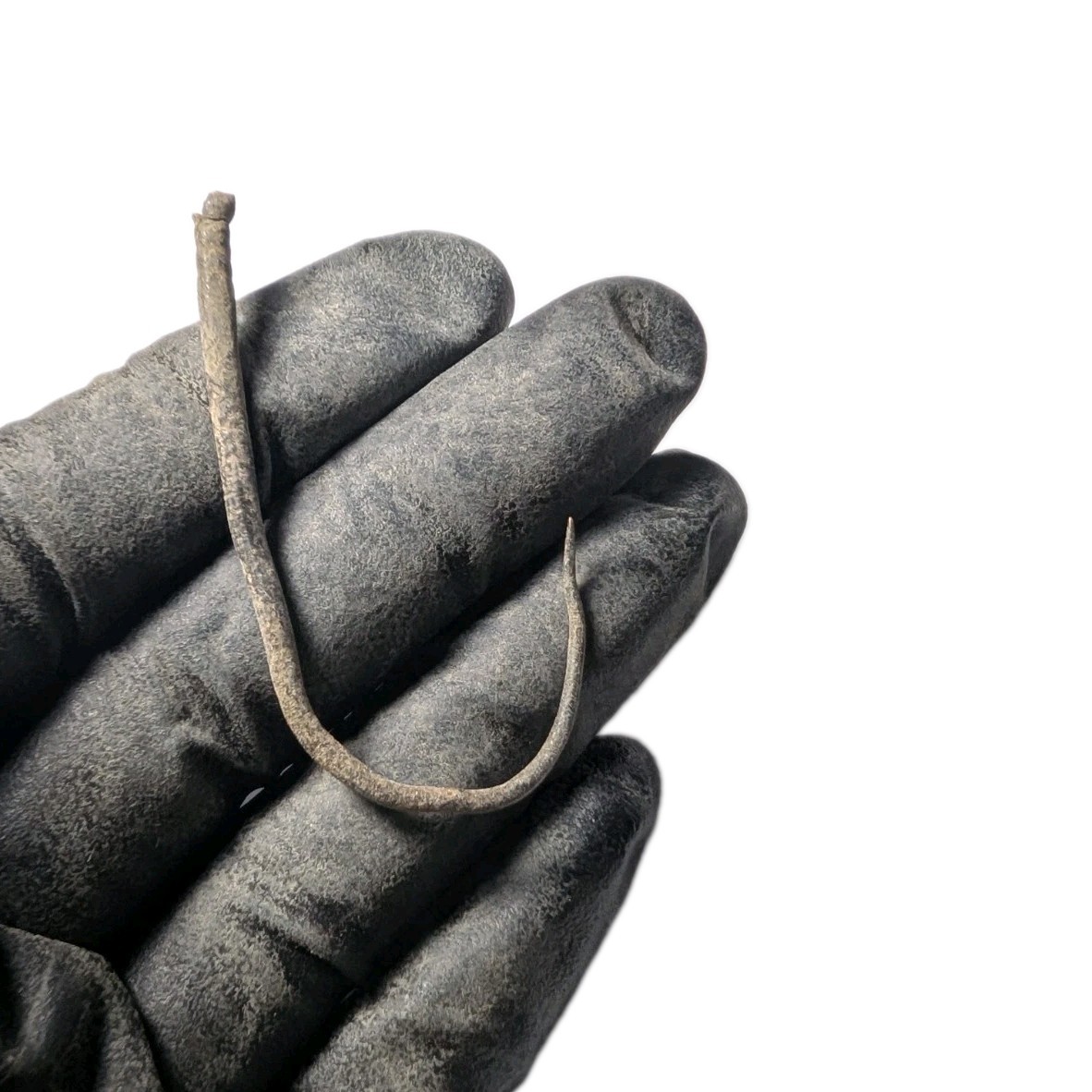
Ancient Roman / Levantine Cast Bronze Fishing Hook (Hamus) (Approx. 5.5cm — c. 1st Century BC – 4th Century AD)
Authenticity & Guarantee
Certification: Certified Authentic — includes signed Certificate of Authenticity (COA) with full provenance documentation.
Provenance: Ex-private European collection, legally acquired from international sales; Roman Levantine / Holy Land Sphere.
Item Specifications & Estimated Dimensions
Object: Hand-Forged / Cast Bronze Fishing Hook (Hamus)
Culture / Period: Ancient Roman Imperial Era (Roman Levant / Sea of Galilee / Mediterranean Sphere)
Date Range: Circa 1st Century BC – 4th Century AD (c. 100 BC – 400 AD)
Estimated Dimensions: Approx. 5.5 cm length (55 mm) × 2.2 cm bend width (Extrapolated from hand scale)
Material: Forged Bronze (Copper Alloy)
Form & Architecture: Heavy round-section bronze wire drawn and hand-forged into a classic deep \'J\' curve; features an upward-pointing barbed tip and a slightly flattened/notched upper shank head engineered to securely bind braided linen or horsehair fishing lines
Condition: Exceptional, 100% complete ancient condition. Original bent hook geometry preserved without breaking, sharp point intact, preserved under an authentic dark charcoal-olive bronze patina with light sandy-earthen burial encrustations. Free of modern restoration or tooling.
Roman Maritime Trade & Levantine Fisheries
In the Roman Mediterranean and the inland waters of Levantine Judaea (such as the Sea of Galilee / Lake Kinneret), fishing was a vital commercial industry. Fishermen operating from harbors like Tiberias, Capernaum, and Caesarea supplied fresh fish to local markets and preserved catch to regional garum (fermented fish sauce) processing centers. Bronze was preferred over iron for maritime tackle because copper alloys resisted saltwater corrosion during extended submersion.
Line Binding & Angling Mechanics
To attach the hook to a fishing line, ancient smiths flattened or slightly grooved the top of the shank. Fishermen bound twisted horsehair, flax, or hemp line around the flattened top, securing it with waterproof pitch or resin. Hooks of this substantial 55mm scale were designed for catching larger predatory fish species such as tilapia (Musht), redbelly tilapia, and sea bass.
Typological Analysis & Exact Classification
Primary Class: Ancient Maritime Equipment / Fishing Tackle
Sub-Class: Hand-Forged Bronze Barbed Hook (Hamus)
Manufacturing Technique: Hand-drawn and forged copper alloy wire bent under heat with cold-chiseled barb.
Comparable Archaeological Examples & Museum Accession Numbers
Israel Museum, Jerusalem: Roman period bronze fishing hooks recovered from Sea of Galilee harbor sites and Migdal.
British Museum (Accession No. 1856,0701.2290): Roman bronze fishing hook with flattened line-attachment shank.
Museum of London (Accession No. 82.225): Roman copper alloy barbed fishhook from waterfront river deposits.

Blog Posts
- Day Trippin' to Southern Colorado Backcountry Streams
Despite flirting with the Big River earlier this summer when I think about fishing in Southern Colorado, I think about backcountry small streams... - Baja Adventures
Aloha, had a great time down in Baja. Some are saying the sun is setting on the fishing in baja... - Back in Southern Colorado
For more than 45 of my 60+ years, I have spent part of my summer in the Southern Rockies... - Why We Fish
In science, some concepts and ideas are so complex or abstract that they defy definition. In order to proceed and communicate...