
Kedge Anchor 1864 Civil War Era | US & British Sailors Inscriptions & Fish Fins For Sale
 When you click on links to various merchants on this site and make a purchase, this can result in this site earning a commission. Affiliate programs and affiliations include, but are not limited to, the eBay Partner Network.

Kedge Anchor 1864 Civil War Era | US & British Sailors Inscriptions & Fish Fins:
$395.00
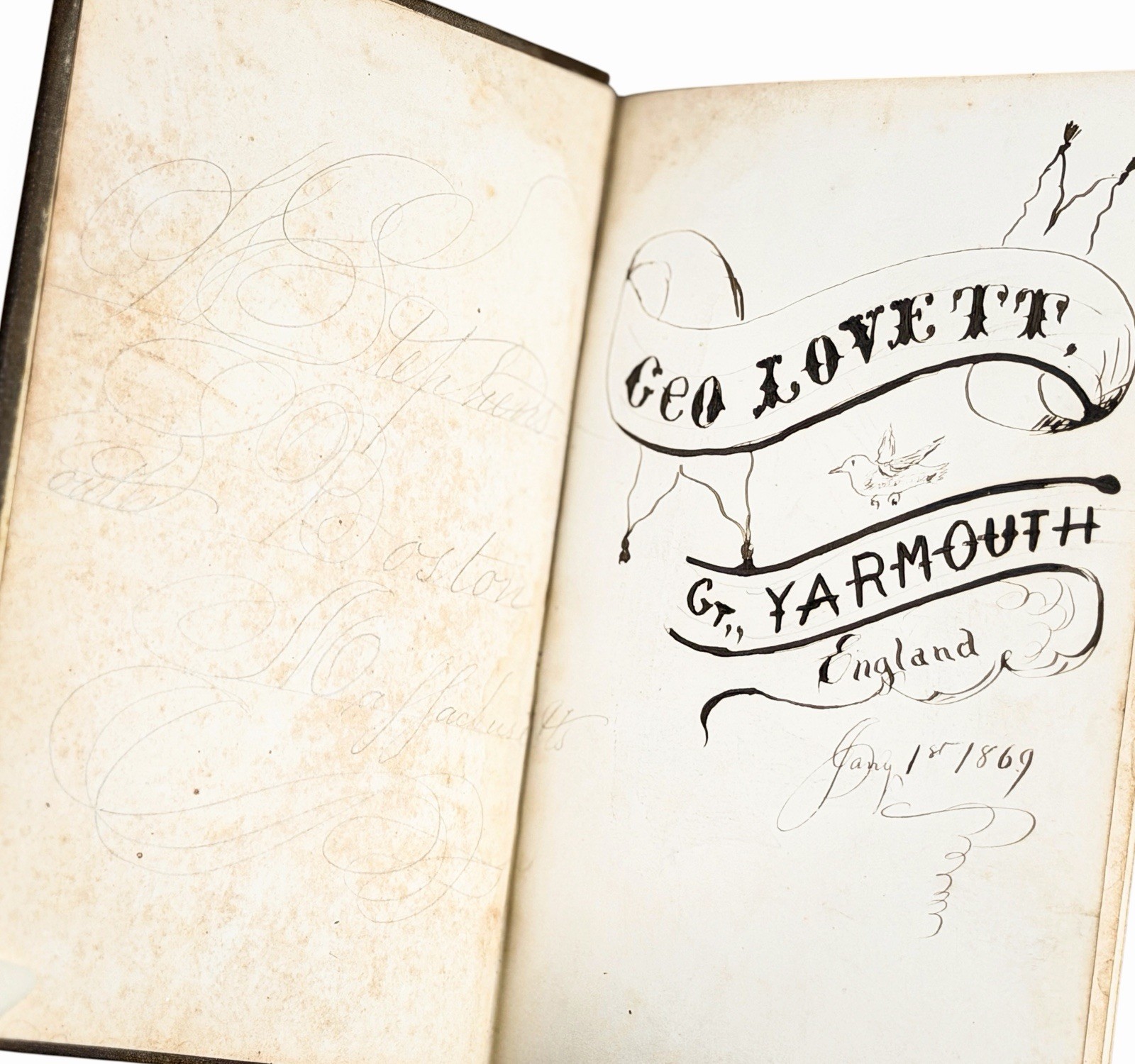
AJ | GILDEDCivil War-Era Sailors' HandbookVictorian inscriptions & preserved fish fins | 1864A cleaner copy could teach you the same knots. It could never tell quite this story.CATALOG DETAILSTitle: The Kedge-Anchor; or, Young Sailors' AssistantAuthor & publisher: William N. Brady; published by the author, New YorkEdition: Eighteenth edition, 1864Binding & Format: Original publisher's blind-stamped clothbound volume with engravings, seamanship instruction and naval reference tablesPublished in New York in 1864, during the American Civil War, this eighteenth edition of The Kedge-Anchor was intended for real work. Its engravings and reference tables taught young sailors the knots, rigging, sails and anchors they needed to manage a vessel. But the people who handled this copy left behind more than evidence of what they learned.The first decorated endpaper introduces Geo. Lovett in ornate pencil lettering, with curling flourishes, the word “England,” and a long pennant marked “GREAT YARMOUTH” flying from a sketched mast. Turn the leaf, and two Atlantic port communities meet across the open book. On the left, W. Stephens of South Boston, Massachusetts, fills the page with pale, sweeping pencil calligraphy. On the right, Lovett's name returns in bold black-ink scrolls identifying Great Yarmouth, England, complete with a tiny flying bird, decorative flourishes and the date January 1, 1869. The name Wm. Stephens appears again in carefully outlined block letters inside the rear cover.Then, tucked between the printed ship diagrams, sailing instructions and U.S. Navy equipment tables, are two dried fish fins. Their fine rays remain spread across the pages, with impressions on the surrounding paper. Souvenirs of a remarkable catch? Something worth showing the folks back home? Whoever placed them here left no explanation, only the fins themselves.The cloth is rubbed and split, the spine covering is lifting, and the leaves carry light water stains, foxing and years of handling. Yet the gilt anchor survives on the spine, the naval illustrations remain beautifully legible and in tact, and these astonishing personal traces are still inside. Not a pristine book kept apart from life, but a book with life still tucked between its pages.CONDITIONGood, heavily used antique condition with worn blind-stamped cloth, lifting to the spine covering, staining, foxing and losses to the front and rear pastedowns. Both boards and the text block remain attached. Pages and plates appear present.AJ | GILDEDTHOUGHTFULLY CURATED | TIMELESS AESTHETIC | ARCHIVAL TECHNIQUE

Blog Posts
- Day Trippin' to Southern Colorado Backcountry Streams
Despite flirting with the Big River earlier this summer when I think about fishing in Southern Colorado, I think about backcountry small streams... - Baja Adventures
Aloha, had a great time down in Baja. Some are saying the sun is setting on the fishing in baja... - Back in Southern Colorado
For more than 45 of my 60+ years, I have spent part of my summer in the Southern Rockies... - Why We Fish
In science, some concepts and ideas are so complex or abstract that they defy definition. In order to proceed and communicate...